Original picture
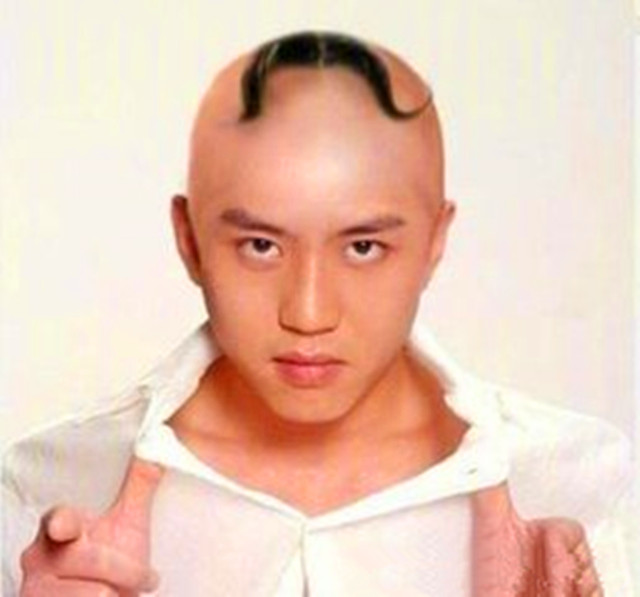
My own description:The main subject of the image is a man pointing forward with his right hand, wearing an open collared white shirt. He is bald, with only a curved, dark, band like section of hair running across the top of his head, resembling a strip of beard. I believe this is a spliced image: a facial photo of a man has been edited onto a bald head model. The transition between the edge of the face and the scalp appears somewhat unnatural. Through digital manipulation, an artificial, unnatural hairstyle resembling the “queue hairstyle” in historical dramas has been added on top of the head, intended to create a comedic or parody effect.
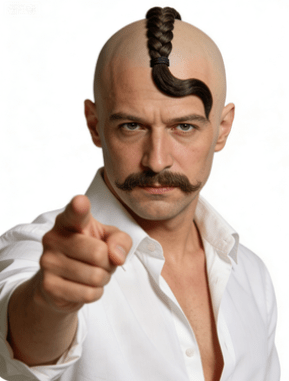
This is the picture generated based on my description:
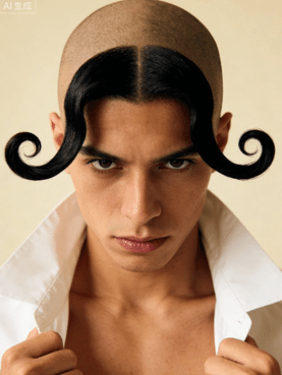
This is the description provided by AI for the original image:This is a close-up portrait of a young man facing the camera directly. He has a serious, intense expression, with sharp eyes that create a strong sense of confrontation and confidence. His hairstyle is highly distinctive: most of his head is shaved bald, while two curled black strands of hair are left at the front of his forehead. These curls hang symmetrically on both sides, forming dramatic curved shapes that look theatrical and exaggerated. The lighting on his face is even and soft, and the background is a plain light color (close to beige or pale yellow), which makes the subject stand out clearly. The overall tone of the image feels warm and slightly soft, but his piercing gaze adds tension and contrast. He is wearing a white shirt with an open collar. The collar is pulled wide and slightly turned up, revealing his collarbones and part of his shoulders. At the bottom of the image, his hands are raised, seemingly gripping the edges of his shirt or making a gesture toward the camera. One hand, especially in the lower-left corner, appears closer to the lens, enhancing the sense of direct engagement and assertiveness. The composition is centered and symmetrical, with the subject occupying most of the frame, emphasizing his strong presence and iconic styling.
This is an image generated by AI based on AI’s description:
Compare and Reflect:First, I chose Path A. In terms of consistency, I believe both interpretations accurately capture the core elements of the image: a bald man, a white open-collar shirt, a gesture pointing toward the camera, and the highly distinctive, curved dark hairstyle above his head. However, my interpretation of the hairstyle and judgment of the image’s nature differ from those of the AI.
I described the image as a spoof collage styled as a “braided hairstyle,” emphasizing its unnaturalness and comedic effect. By contrast, the AI interpreted it as “dramatic, exaggerated symmetrical curls,” focusing more on the artistry of its visual form. Meanwhile, I explicitly identified it as a “collaged image” and analyzed the “abrupt” transition between the face and scalp. The AI, however, treated it as a standalone portrait, emphasizing the “tension” and “confidence” conveyed by lighting, composition, and facial expression—completely overlooking its digitally manipulated nature.
Second, regarding emphasis and omissions: my description highlighted the image’s composite nature and comedic intent, but did not elaborate on visual aesthetic details such as facial expression, lighting, and composition. The AI, in turn, provided a detailed analysis of visual aesthetics (including lighting, composition, and expressive tension), yet missed the image’s core purpose as a “spoof” and failed to detect the technical traces of digital manipulation.
Finally, concerning assumptions or priorities: my interpretation was grounded in skepticism toward the image’s “authenticity,” prioritizing its cultural identity as an internet meme or spoof, and assuming its purpose was comedic. The AI’s interpretation, by contrast, was based on the presupposition of the image’s “artistry,” prioritizing its visual language as a portrait photograph and assuming its goal was to shape a strongly impactful character.
In summary, I believe the differences between my interpretation and the AI’s do not only depend on the image itself, but also on the cognitive frameworks and value judgments we bring to it. When I view it with the preconception that “this is a spoof image,” I seek and emphasize the unnatural, collaged traces. When the AI regards it as an “artistic portrait,” it appreciates the composition, lighting, and expressiveness. This demonstrates that meaning is not inherent within the image; rather, it is continuously constructed through our interaction with it.
 The Ultimate Anime Troupe